
Utopia fills the void that dystopia would otherwise claim. The Atlantic Union offers a strategic architecture built to make the revisionist model irrelevant, without firing a shot.
Утопія заповнює порожнечу, яку інакше зайняла б антиутопія. Атлантичний Союз пропонує стратегічну архітектуру, покликану зробити ревізіоністську модель нерелевантною, без жодного пострілу.
Утопия заполняет пустоту, которую иначе заняла бы антиутопия. Атлантический Союз предлагает стратегическую архитектуру, призванную сделать ревизионистскую модель нерелевантной, без единого выстрела.
Utopia fills the void that dystopia would otherwise claim. The Atlantic Union offers a strategic architecture built to make the revisionist model irrelevant, without firing a shot.
Russia today occupies a position comparable to Germany’s after the First World War: a power whose imperial logic must be outcompeted before durable peace becomes possible. Not destroyed. Not humiliated into a second Versailles. But structurally weakened, until that logic collapses under its own economic and demographic weight.
So how do we weaken a nuclear power without fighting a nuclear war? Not through military escalation alone, but through economics, alliances, and the patient construction of a world where the revisionist model simply stops working.
Consider what holds the BRICS bloc together. It is not shared values, nor trust between leaders. It is resentment: a common grievance against the Western-led order that functions as political glue for regimes with little else binding them.
That glue can dissolve, not by force but by attraction: by building an Atlantic economic and defense community, with or without the United States, from Europe to Latin America, from Scandinavia to South Africa, prosperous enough, democratic enough, and genuinely open enough to the Global South that the anti-Western narrative loses its audience, country by country, generation by generation.
When the Global South sees a credible alternative, concrete partnerships and fair trade rather than lectures on democracy, the cohesion holding BRICS together will weaken. And with it, the political survival of leaders who depend on that grievance to remain in power.
Ukraine’s integration into the European Union marks where this larger story begins. It is not charity, nor sentiment. It is the first irreversible step of a new European architecture: serious enough to deter aggression, generous enough to inspire partnership, and durable enough to make lasting peace a structural reality rather than a hope.
Europe forgave Germany and built something extraordinary from it. One day, Europe and its Atlantic partners will extend that same reconciliation to Russia and to China, not because either has earned it yet, but because reconciliation, offered at the right moment, is among the most effective instruments a civilization can use.
That moment is not today. Today is for building the conditions that make it possible.
What Ukraine protects with blood, we must anchor in law, in institutions, and in an Atlantic community worthy of the peace it intends to secure.
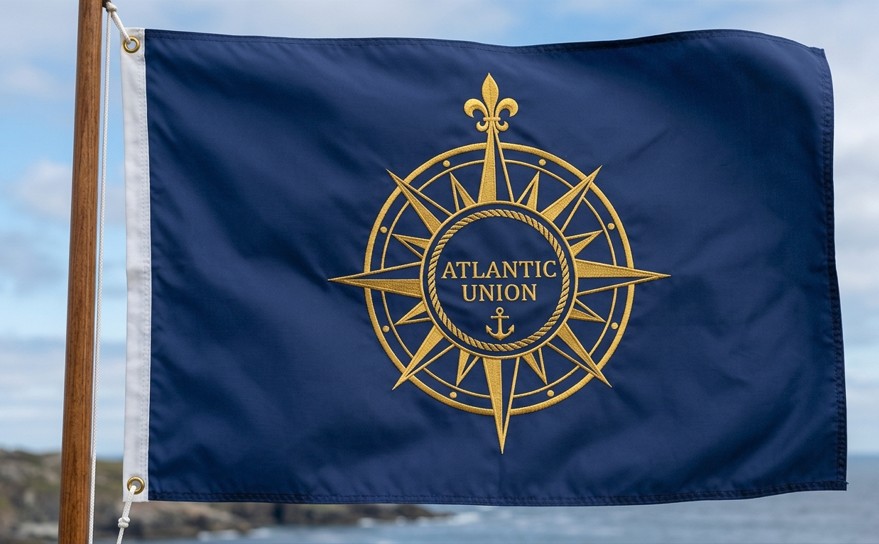

Utopia fills the void that dystopia would otherwise claim. The Atlantic Union offers a strategic architecture built to make the revisionist model irrelevant, without firing a shot.
Утопія заповнює порожнечу, яку інакше зайняла б антиутопія. Атлантичний Союз пропонує стратегічну архітектуру, покликану зробити ревізіоністську модель нерелевантною, без жодного пострілу.
Утопия заполняет пустоту, которую иначе заняла бы антиутопия. Атлантический Союз предлагает стратегическую архитектуру, призванную сделать ревизионистскую модель нерелевантной, без единого выстрела.
Utopia fills the void that dystopia would otherwise claim. The Atlantic Union offers a strategic architecture built to make the revisionist model irrelevant, without firing a shot.
Russia today occupies a position comparable to Germany’s after the First World War: a power whose imperial logic must be outcompeted before durable peace becomes possible. Not destroyed. Not humiliated into a second Versailles. But structurally weakened, until that logic collapses under its own economic and demographic weight.
So how do we weaken a nuclear power without fighting a nuclear war? Not through military escalation alone, but through economics, alliances, and the patient construction of a world where the revisionist model simply stops working.
Consider what holds the BRICS bloc together. It is not shared values, nor trust between leaders. It is resentment: a common grievance against the Western-led order that functions as political glue for regimes with little else binding them.
That glue can dissolve, not by force but by attraction: by building an Atlantic economic and defense community, with or without the United States, from Europe to Latin America, from Scandinavia to South Africa, prosperous enough, democratic enough, and genuinely open enough to the Global South that the anti-Western narrative loses its audience, country by country, generation by generation.
When the Global South sees a credible alternative, concrete partnerships and fair trade rather than lectures on democracy, the cohesion holding BRICS together will weaken. And with it, the political survival of leaders who depend on that grievance to remain in power.
Ukraine’s integration into the European Union marks where this larger story begins. It is not charity, nor sentiment. It is the first irreversible step of a new European architecture: serious enough to deter aggression, generous enough to inspire partnership, and durable enough to make lasting peace a structural reality rather than a hope.
Europe forgave Germany and built something extraordinary from it. One day, Europe and its Atlantic partners will extend that same reconciliation to Russia and to China, not because either has earned it yet, but because reconciliation, offered at the right moment, is among the most effective instruments a civilization can use.
That moment is not today. Today is for building the conditions that make it possible.
What Ukraine protects with blood, we must anchor in law, in institutions, and in an Atlantic community worthy of the peace it intends to secure.